


If you’ve been online recently, you may have seen graphics from Lead Safe Mama, a well-known activist and blogger who has built a large following by testing consumer products for toxicants like lead, cadmium, mercury, and arsenic. Her mission is admirable on the surface: she wants to hold companies accountable and protect families, especially children from unnecessary exposure to heavy metals.
Lead Safe Mama has done important work in the past, such as raising awareness about lead in vintage dishes, toys, household products and food where ingestion risks are real. She positions herself as a watchdog, especially in cases where manufacturers downplay contaminants. That role has value and is important.
But when it comes to cosmetics and skincare, her reporting takes a sharp turn and it can end up misleading consumers.
The Problem with Her Cosmetic Reporting
One of the main issues with Lead Safe Mama’s charts is that she uses drinking water and baby food standards which is 5 ppb for lead as her benchmark for skincare. These numbers were created for ingestion-based products, meant to protect children who drink water and eat food multiple times a day. Cosmetics, however, are not food. Dermal absorption of heavy metals is extremely limited, yet her reporting frames sunscreen, makeup, and other topical products as if they’re being swallowed like a glass of water.
This choice of standard leads to inflated percentages that look shocking at first glance. In one example, a sunscreen tested at 923.8 ppb lead. When compared to the 5 ppb baby food standard, she calls it 18,476% over the limit 🚨. But when compared to the FDA’s actual cosmetic guidance of 10,000 ppb, the same result comes out to just 9.2% of the limit ✅ well within range.
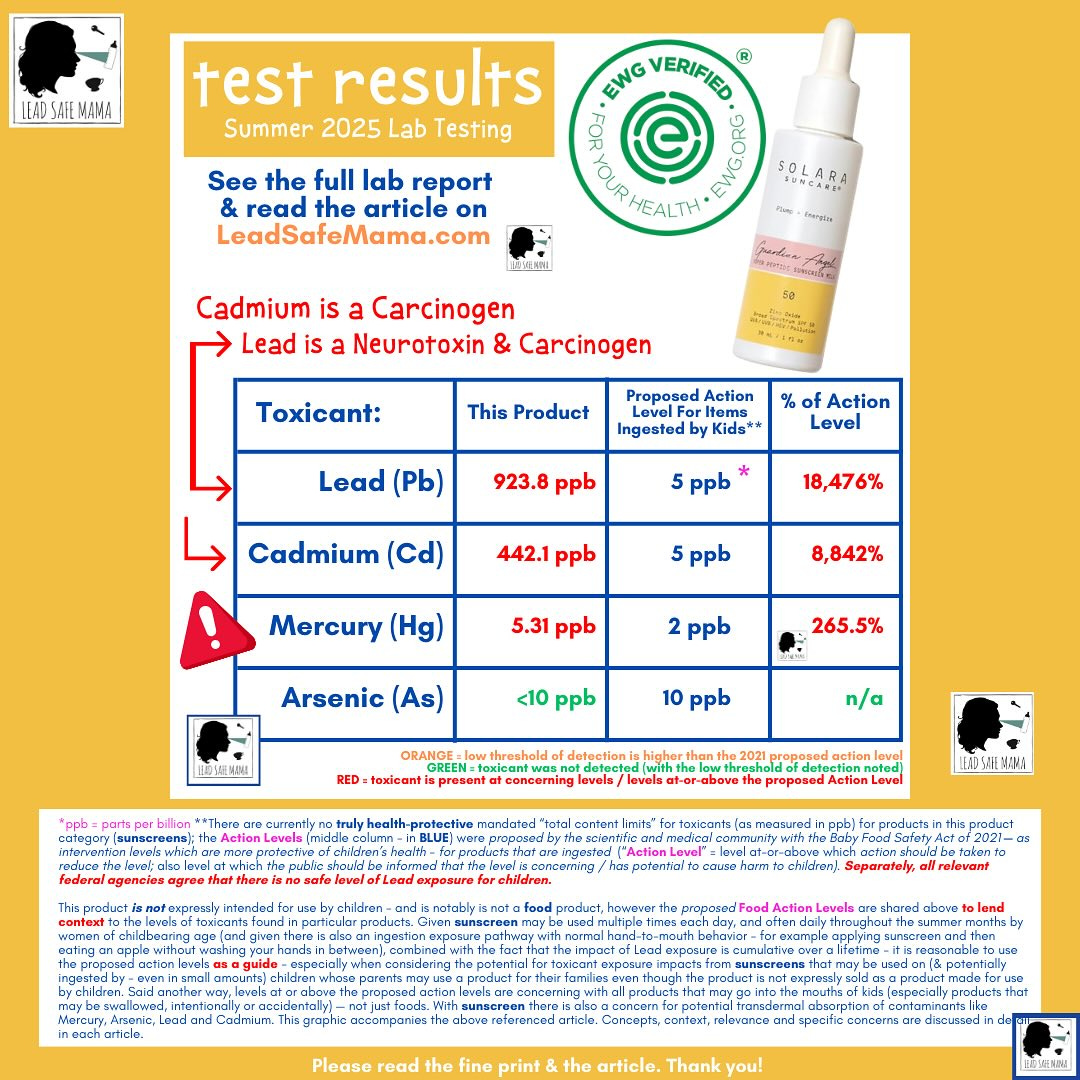
The third problem is fear without context. Her graphics rarely clarify that the “limits” she’s using aren’t legally mandated for cosmetics. In the fine print she does disclose she’s using drinking water standards to base cosmetic results off of. To the average reader, this makes it appear as if brands are selling wildly unsafe products, when in reality the numbers fall far below established cosmetic safety thresholds.
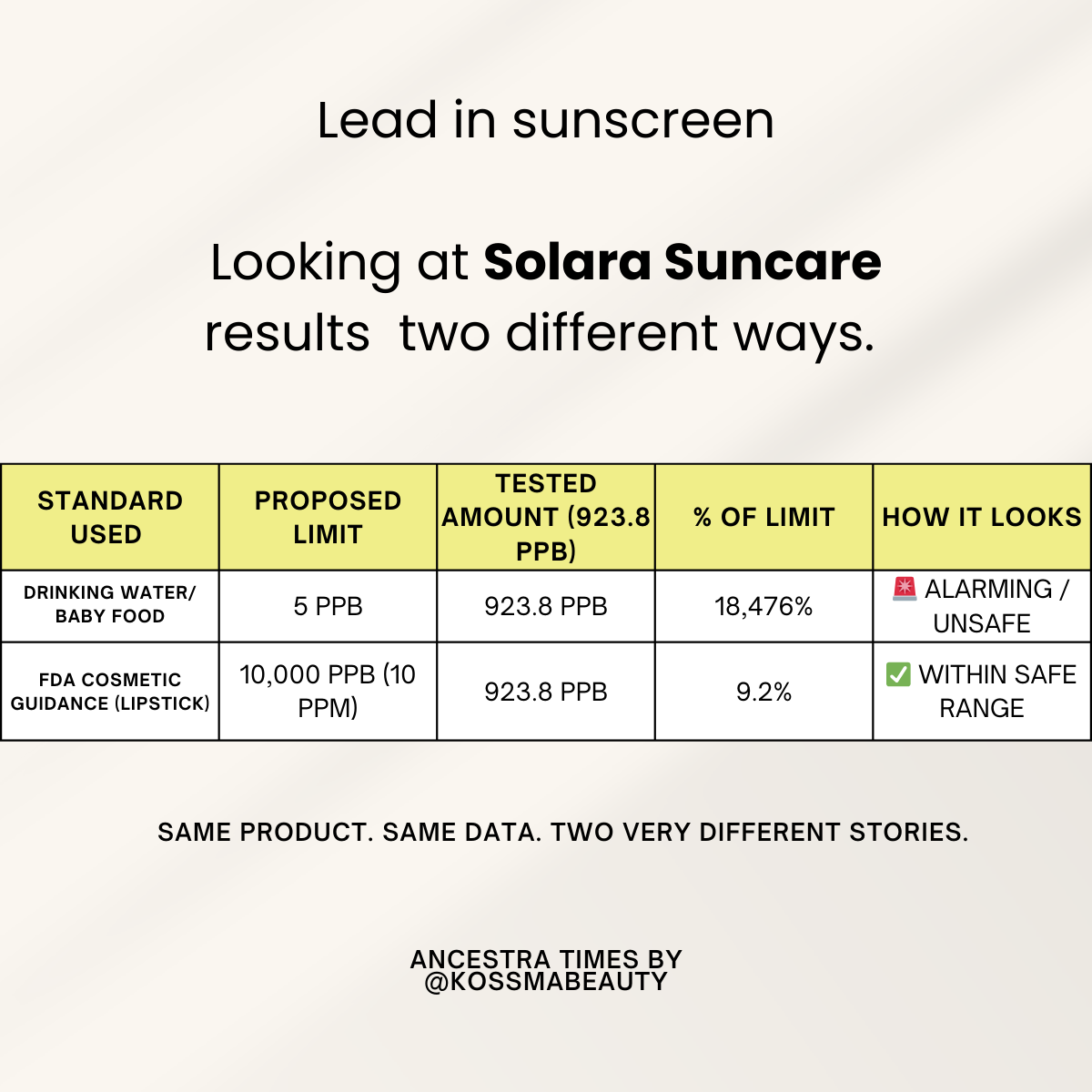
Failed to render LaTeX expression — no expression found
The number 923.8 ppb represents the concentration of lead measured in the sunscreen sample. To put that in perspective, if you had a standard 3 oz (85 g) tube of sunscreen, the total lead content at that concentration would be measured in micrograms, not milligrams or grams. It’s a trace amount, not a heavy load. This is exactly why regulators distinguish between ingestion-based standards and topical-use standards: while the number may sound big when expressed as a percent over baby food limits, the absolute amount present in an entire tube is very small.
When Challenged on Her Testing
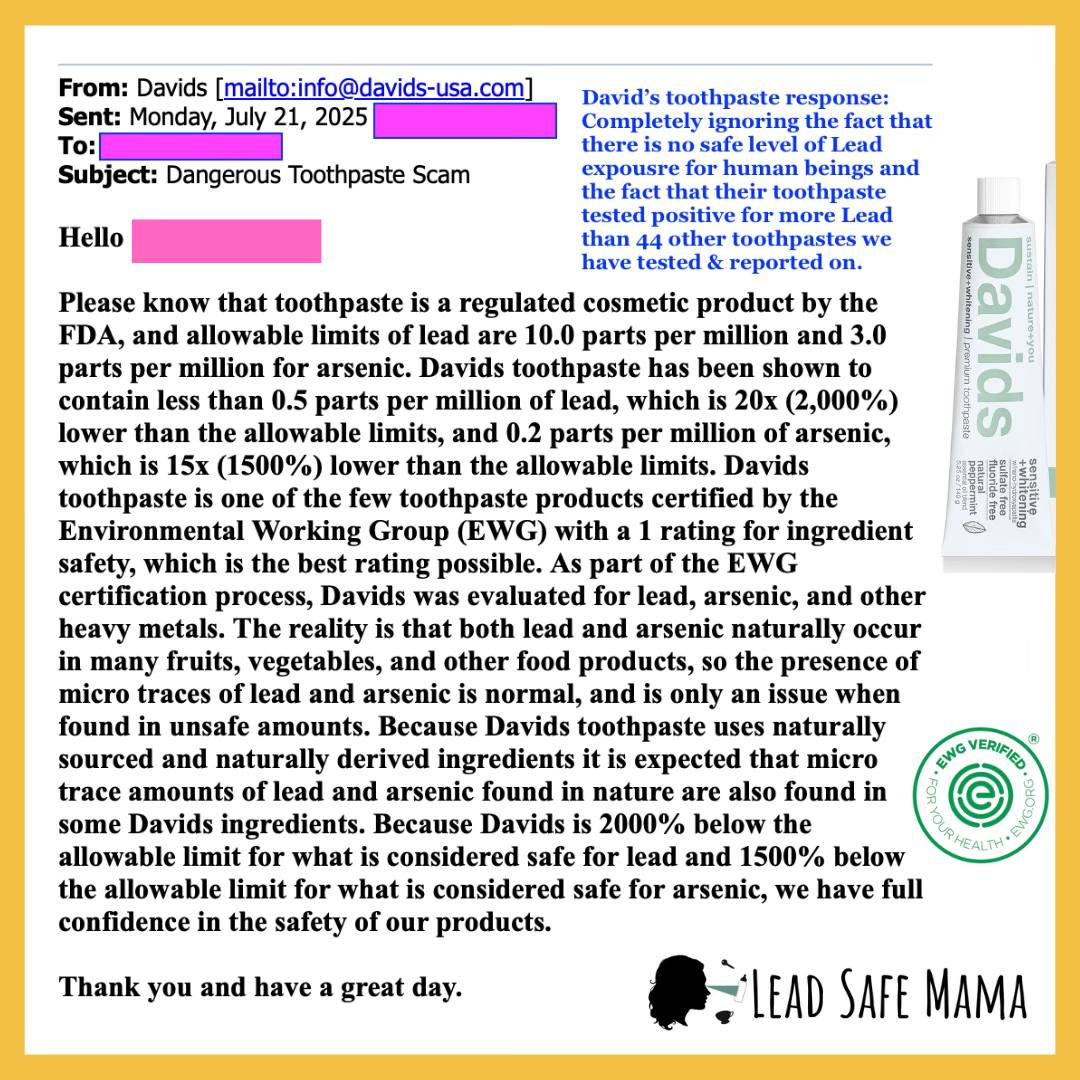
When confronted about why she applies drinking water standards to cosmetics, Lead Safe Mama does not directly address the question. In her fine print, she acknowledges that there are no federally mandated limits for heavy metals in sunscreen or skincare, yet when pressed, she usually falls back on the line: “there’s no safe level for lead.”
While it’s true that lead is a neurotoxin and best avoided when possible, this answer sidesteps the actual concern. By refusing to explain her choice of benchmark, she dismisses legitimate questions from both consumers and business owners who want clarity. Instead of engaging with nuance such as the difference between ingestion and topical exposure, she leans on an absolutist statement that ignores context.
Why This Matters
Heavy metals like lead aren’t some artificial additive that brands sneak into products. They exist naturally in the environment; in soil, plants, herbs, and even the foods we eat every single day. Trace levels in natural products are unavoidable.
The key isn’t zero exposure (which is impossible). The key is keeping exposure at levels the body can safely handle. And our bodies are designed with detox systems through the liver, kidneys, and gut that can process and eliminate small amounts of heavy metals. Low-level exposure, when it falls under safety thresholds, is not the same as a dangerous toxic load.
This is why context matters. Food is ingested in large quantities daily, which is why standards are extremely strict. Cosmetics, on the other hand, involve topical exposure with minimal absorption, which is why thresholds are set differently. When food standards are applied to skincare, safe products can suddenly look catastrophic when they’re not.
What to Watch For Instead
If you want to make informed choices about skincare safety, it helps to focus on a few things that matter more than scary graphics. First, look at the standards that actually apply to cosmetics. The FDA has issued draft guidance for lead in lipstick and externally applied products, setting a limit of 10 ppm (10,000 ppb). Products that test below that level are considered safe for topical use.
Transparency from brands is another key factor. Companies that share their sourcing practices, do third-party testing, or clearly communicate their quality standards are the ones worth trusting. By contrast, vague “clean” claims with no data, or brands that lean on fear marketing deserve more skepticism.
It’s also important to understand dermal absorption. Heavy metals like lead have very low absorption rates through skin compared to ingestion, which is why the standards differ so dramatically. And finally, pay attention to the ingredients that truly matter. Is the product free from problematic fillers, high-PUFA seed oils, or endocrine-disrupting preservatives? Does it use whole-herb extracts and nourishing bases that the skin can recognize and benefit from? Those factors matter far more than trace, naturally occurring levels of metals.
The Bottom Line
Lead Safe Mama has helped raise awareness about hidden toxins in products, but her application of food standards to cosmetics is misleading. It paints safe products as dangerous and spreads unnecessary fear.
Consumers deserve better: clear context, accurate comparisons, and actionable ways to evaluate what goes on their bodies.
Why This Matters for the Natural Movement
What worries me most isn’t just the numbers it’s the way fear gets used to drive attention. When influential voices exaggerate or misapply standards, it gives the impression that everything is toxic and unsafe. That kind of messaging doesn’t empower people, it paralyzes them.
And that’s part of what’s wrong with how the natural or “crunchy” movement is sometimes portrayed. Instead of building trust and teaching people to discern what really matters, fear-based reporting drives them away. It makes outsiders roll their eyes and insiders burn out from the idea that danger lurks in every bottle, every bite, every product. It’s exhausting.
Yes, we should question ingredients and hold companies accountable. But we also need honesty, context, and perspective. Otherwise, the movement that should be drawing people closer to ancestral wisdom, real food, and safer products ends up pushing them away with overwhelm.
✨ Looking for skincare that’s built on context, not fear?
At Kossma, every formula is made in our Arizona apothecary with whole-herb extracts, PUFA-aware oils, and ancestral fats like tallow and ghee. No seed oils. No essential oils. No fear marketing. Just products rooted in transparency, tradition, and ingredients your skin actually recognizes.
💛 Trusted by more than 80,000 women worldwide and backed by hundreds of five-star reviews, Kossma has become one of the most loved tallow-based skincare brands in the world.
🌿 Explore the collection here: kossmabeauty.com
Spread the word 👏
This was such a good message. Thank you